The Self Serve Operating Model
How High-Performance IT Organizations Really Work

In my last article I explained how the High Touch IT operating model, the model that creates productivity disasters, actually works. I explained how the "Call the Expert" model transforms simple tasks into multi-month ordeals. And previously, I discussed some of the symptoms High Touch organisations generally see, including the Company Queue and the Empty Landing Zone. But here's the question that matters: What's the alternative?
Most IT professionals know there's a better way. They read about companies deploying dozens of times per day, scaling to millions of users, and innovating at startup speed. They see cloud-native organizations delivering in minutes what takes their teams months.
How do they do it? By implementing a Self Serve operating model.
Just likely the High Touch model at your organisation, Self Serve is the water your competitors swim in. It's so natural to them, so embedded in how they work, that it becomes their competitive advantage. You don't see Self Serve delivery—you just see "how modern IT works." But once you understand its anatomy, you'll recognise the difference: from one designed for on-premise infrastructure requiring expert mediation to one designed for cloud infrastructure and self service. The former leaving your IT organisation slow, costly and error-prone. The latter making your competitors fast, cost-effective and high quality.
In this article, I'll dissect the Self Serve operating model across the same eight critical dimensions I used with the High Touch Operating Model in my previous article. By the end, you’ll see the difference between the two operating models and why cloud-native organisation are able to deliver in minutes instead of months.
Eight Dimensions of Excellence
Let’s dive into the Self Serve operating model using the same eight interconnected dimensions that we used for the High Touch operating model. It might help to have both this article and the High Touch article open at the same time. As before, each dimension reinforces the others, though this time it creates a self-sustaining system that delivers extraordinary productivity gains. Let's go.
1. Process: The "Do it Yourself" Platform
How Self Serve Works: Your IT processes are built around the fundamental principle: "Do it Yourself." Need a server? Use the self-service portal. Want a database? Select from the service catalog. Require networking? Configure it through the platform interface. Do not, under any circumstances, call an expert!
This creates a completely different process pattern:
Service Interfaces - Users interact directly with well-designed interfaces (web UIs, APIs, CLIs, SDKs)
Automated Workflows - Complex orchestration happens behind the scenes, invisible to users
Immediate Delivery - Resources provisioned in minutes, not weeks
Why This Works:
Every IT interaction starts with "how do I do this myself?" rather than "who do I need to call?"
Platform documentation guides users through self-service, not experts through manual processes
Changes happen through automation, not human review and approval
2. Organization Structure: Service-Oriented Teams
How Self Serve Works: Your IT department is organized around business services, not technology domains. You have two types of teams: Application teams that build and operate applications and services for customers and internal staff, and Platform teams that build self-serve platforms for application teams to use.
The org chart looks something like this:
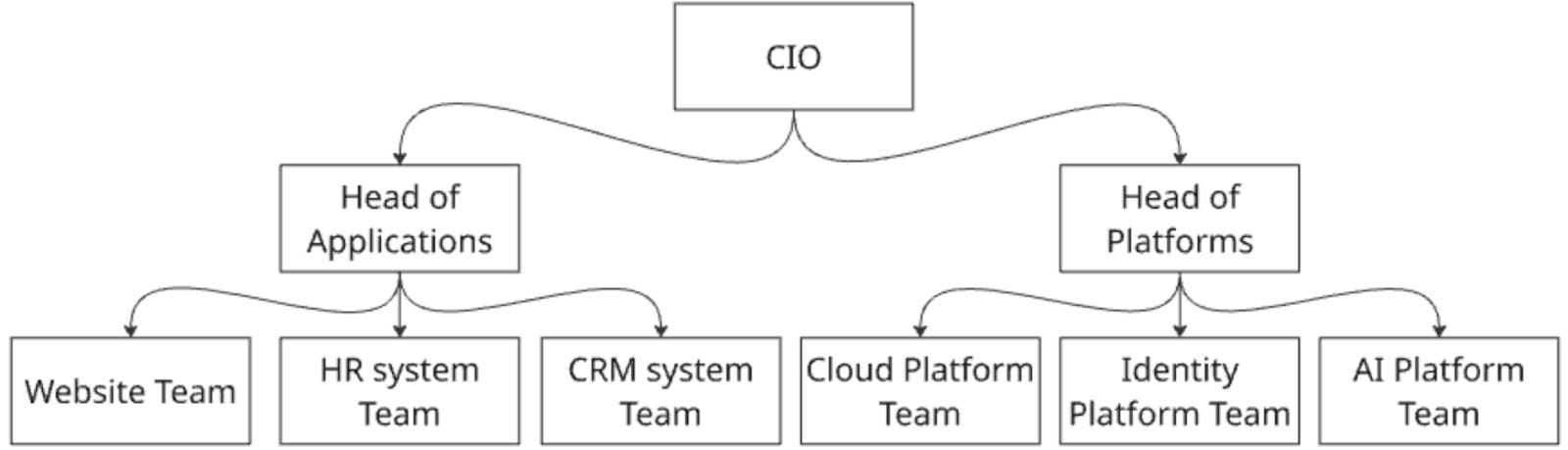
Why You'll Recognize Success:
When you need something that spans technologies, one team owns the complete service
Team names reflect a platform or business service (Identity Platform Team, Website Team) rather than technologies
Career paths are defined by service delivery capability and business impact
3. Governance: Governance as a Service
How Self Serve Works: Your governance model assumes that risk is managed through automated controls and policy-as-code. Instead of preventing bad decisions through committee approval, you make bad decisions impossible by designing platforms that only offer acceptable alternatives.
Policy-as-Code: Governance rules expressed as executable code, not documents
Built-in Controls: Security, compliance, and operational standards embedded in every platform service
Acceptable Alternatives: Users choose from pre-approved options that are compliant by design
Continuous Monitoring: Automated detection and response rather than periodic reviews
Why You'll Recognize This:
Governance processes add seconds to delivery timelines, not weeks
Compliance happens automatically because non-compliant choices aren't available
Risk mitigation means "build controls into the platform" rather than "get approval from committees"
4. RACI: Service Ownership with Clear Boundaries
How Self Serve Works: Your roles and responsibilities are defined by service ownership, not technical tasks. Clear demarcation exists at service boundaries: Platform teams own everything below the service interface, Application teams own everything above it.
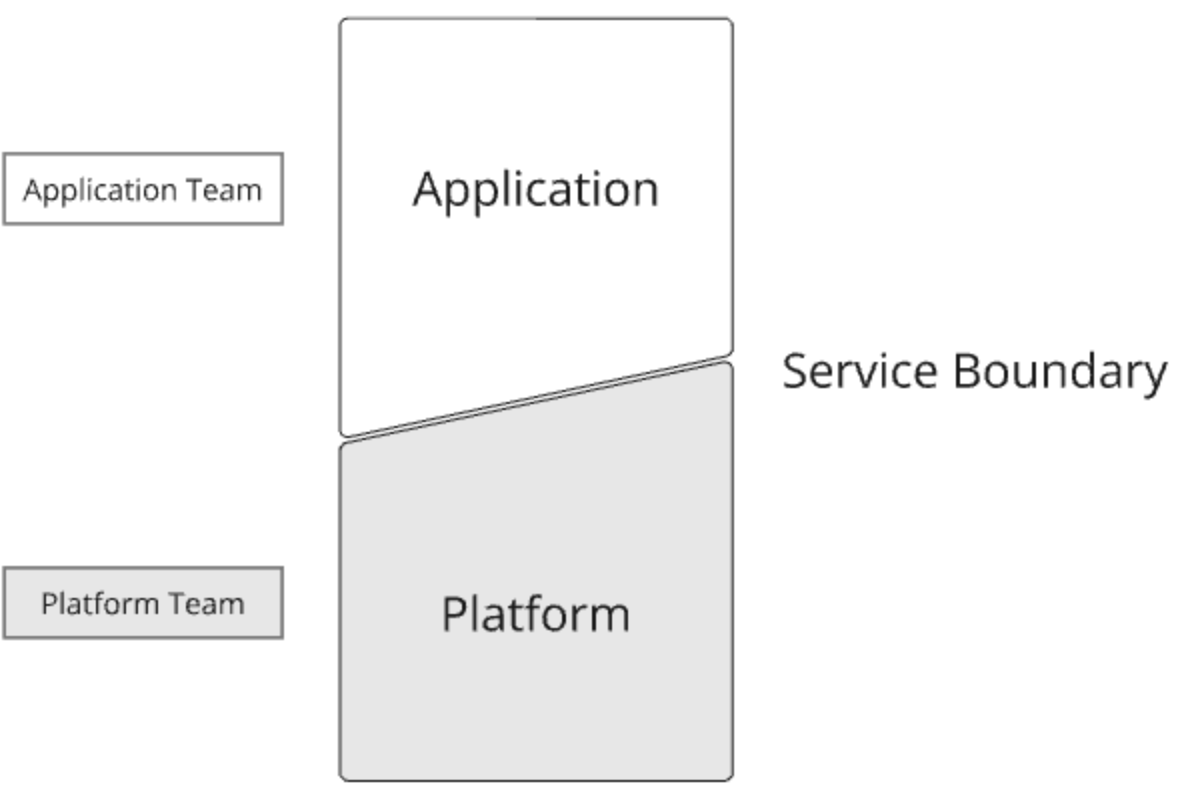
Platform Team Ownership:
Service availability, performance, and security
Platform evolution and improvement
User experience and self-service capabilities
Everything "below" the service interface (APIs, infrastructure, etc.)
Application Team Ownership:
Business logic and customer features
Application performance and user experience
Business outcomes and value delivery
Everything "above" the service interface (code, data, workflows)
Why You'll Recognize This:
Simple changes don't require "touching base" with multiple teams
When something goes wrong, service ownership is clear and unambiguous
Teams collaborate across well-defined interfaces rather than complex handoff matrices
5. Delivery Model: Product Development with Continuous Improvement
How Self Serve Works: Your delivery model treats all IT services as products requiring continuous evolution. Single permanent teams own services from conception through their entire lifecycle, eliminating the artificial split between building and running.
Product Teams (not Project Teams):
Permanent teams with ongoing funding and clear business outcomes
Optimized for customer value and continuous improvement
Success measured by user adoption, satisfaction, and business impact
No handovers—same team builds, runs, and continuously improves
Continuous Evolution (not Discrete Projects):
Regular feature releases based on user feedback and business needs
Technical debt addressed as part of ongoing improvement, not deferred
Architecture evolves incrementally rather than through big-bang redesigns
Why You'll Recognize This:
Teams own business outcomes, not just technical deliverables
"Technical debt" gets addressed through continuous improvement, not separate projects
Your best engineers work on platform evolution while also supporting production systems
6. Tooling: User-Friendly Platforms for Direct Access
How Self Serve Works: Your tooling landscape provides application teams with direct access to everything they need through intuitive, integrated platforms. No separate user tools designed for request submission and ticket routing or expert tools for complex tasks.
Unified Self-Service Platforms:
Service catalogs with clear options and instant provisioning
APIs and CLIs for automation and integration
Dashboards showing real-time resource usage, costs, and performance
Built-in monitoring, logging, and troubleshooting capabilities
Platform-as-Product Approach:
Platforms designed for user experience, not expert convenience
Integrated workflows that span multiple technical domains to deliver business-ready services.
Self-service capabilities for the complete service lifecycle (create, modify, monitor, delete)
Why You'll Recognize This:
Application teams can provision and manage resources without calling experts
Platforms hide technical complexity while providing powerful capabilities
Self-service extends to the complete service lifecycle, not just initial provisioning
7. Industry Standards: Agile and DevOps Practices
How Self Serve Works: Your teams follow modern frameworks designed around continuous delivery, automation, and rapid feedback rather than expert-mediated processes and committee-based decision making.
Scaled Agile Framework (SAFe): Enterprise agility enabling continuous delivery at scale
DevOps Practices: Collaboration, automation, and integration between development and operations
Supporting Practices: Lean principles, Kanban workflows, Site Reliability Engineering (SRE), Platform Engineering
Why You'll Recognize This:
Process documentation emphasizes automation and self-service rather than manual procedures
Governance discussions focus on "capabilities" and "enablement" rather than "controls" and "approval authorities"
Training programs teach platform building, user experience design, and service delivery
8. Metrics: External Outcome Focus
How Self Serve Works: Your measurement systems optimize for customer and business outcomes rather than internal team efficiency. Metrics focus on value delivered to users and business impact achieved.
External Value Metrics:
Time to deliver: End-to-end delivery time from request to working service
Cost efficiency: Total cost of service delivery including platform and application costs
Feature utilization: How much platform capabilities are actually used by application teams
Customer impact: Business outcomes achieved through IT service delivery
Business-Aligned Measurement:
Platform teams measured by application team productivity and satisfaction
Application teams measured by customer value and business outcomes
Organization measured by competitive advantage and market responsiveness
Why You'll Recognize This:
Dashboards show business outcomes alongside technical metrics
Performance reviews focus on customer value delivered, not internal process compliance
When delivery is fast, metrics show external impact rather than internal efficiency
The System Was Designed for Cloud Technology
The Self Serve operating model is a rational response to the realities of cloud infrastructure and modern software delivery. Your organization structure creates service ownership because cloud platforms enable end-to-end automation. Your delivery model emphasizes continuous improvement because cloud resources can be modified instantly and safely. Your governance focuses on built-in controls because cloud platforms can enforce policies automatically.
Every dimension reinforces the others because they are all built on the “do it yourself” principle:
Service-oriented teams make sense when platforms can hide technical complexity behind well-designed service interfaces
Direct user interaction becomes possible when self-service platforms eliminate the need for expert interpretation
Built-in governance works when platforms can enforce policies automatically
Continuous improvement aligns with cloud's ability to make frequent, low-risk changes
Service ownership clarifies responsibilities in a world where boundaries are defined by APIs
Outcome-focused metrics work when delivery times enable rapid feedback and iteration
Agile frameworks provide structure for managing rapid, automated changes
Platform tooling enables direct user productivity rather than expert mediation
Cloud computing has fundamentally enabled every assumption that makes Self Serve feasible:
Infrastructure is now software-defined and instantly modifiable, not physical and expensive to change
Platforms expose capabilities through user-friendly interfaces, not complex technical consoles
Mistakes can be automatically prevented or quickly corrected, not costly and time-consuming to resolve
Changes can be frequent and automated, not infrequent and manual
Resources can be provisioned instantly on-demand based on actual need
The Self Serve operating model is optimized for cloud infrastructure. This perfect fit between operating model and technology platform is why cloud-native organizations achieve such extraordinary productivity gains.
The Transformation Moment
As you read this breakdown, you're probably recognizing what your organization could become. The self-service portals that eliminate waiting. The team structure that eliminates handoffs. The automated governance that eliminates approval delays. The continuous improvement that eliminates technical debt. The integrated platforms that eliminate expert mediation. The agile practices that eliminate bureaucracy. The outcome metrics that eliminate internal optimization. The platform approach that eliminates coordination overhead.
This recognition is crucial because Self Serve isn't a collection of separate improvements—it's a coherent system. You can't achieve it by optimizing individual pieces. Self Serve productivity requires a systematic response: transforming your entire operating model from expert-mediated to self-service. From processes built around "Call the Expert" to platforms built around "Do it Yourself."
The Reality Check: This Won't Happen Overnight
Now that you can see Self Serve delivery for what it really is - a complete operating model systematically designed for cloud technology's self-service, on-demand, pay-per-use capabilities - let's acknowledge the uncomfortable truth: shifting from from High Touch to Self Serve is difficult.
The transformation takes years, not months. It requires sustained executive commitment, significant cultural change, and careful sequencing across all dimensions. Organizations that have successfully made this shift typically take 2-3 years to complete the transformation, and that's with dedicated focus and resources.
But here's the opportunity: you don't need to wait for a perfect moment to start. Transformation happens during periods of major change when budgets are allocated and organizational attention is focused. Two prime opportunities exist:
Cloud Migration - If your organization is currently migrating to the cloud, you have a unique opportunity. Cloud migration projects already have:
Executive sponsorship and transformation mandates
Dedicated budgets for organizational change
Technical teams learning new platforms and approaches
Business expectations for improved agility and speed
The mistake most organizations make is treating cloud migration as purely a technical lift-and-shift. Instead, use migration as the catalyst for operating model transformation. Don't just migrate applications - migrate teams to Self Serve delivery.
AI Revolution - If your cloud migration is already complete but you’re still using the High Touch operating model, the AI revolution presents the next major transformation opportunity. Organizations are currently allocating massive budgets to AI initiatives, creating another window for systematic change.
Of course, many are making the same mistake as with Cloud: organizations are treating AI adoption as purely a technical capability upgrade. They're building AI platforms and training models while maintaining High Touch delivery for everything else. This creates AI "sugar hits"—impressive demos and pilot projects that don't translate into sustained productivity improvements.
The opportunity is to harness AI transformation budgets to drive broader Self Serve adoption and consequently embed lasting productivity improvements across the organisation. Use AI initiatives to justify platform teams, self-service capabilities, and automated workflows that benefit the entire organization, not just AI use cases.
What's Next? Seizing Your Transformation Moment
The Self Serve operating model isn't wishful thinking—it's proven, practical, and achievable. But it requires recognizing and seizing transformation opportunities when they arise.
The technology exists. The patterns are proven. Your competitors may already be operating this way. The question is: will you use your next major initiative to drive real operating model transformation, or will you repeat the pattern of technical upgrades that leave your productivity problems unsolved?
In my next few articles, I'll show you exactly how to harness either your Cloud migration or your AI transformation to drive Self Serve adoption across your entire organization. Because Cloud and AI are not just about technology - they are about using the moment to finally eliminate the productivity barriers that have held your organization back.